President Donald Trump is once again turning his medical checkups into political theater. In a Truth Social post on July 11, 2026, the 80-year-old commander-in-chief claimed he had “just finished a perfect physical at Walter Reed” and requested yet another cognitive test — declaring himself the only president to take one three times and that he “aced them all — Got every question right.”
The timing raised eyebrows. White House pool reports placed Trump on the golf course that Saturday. His most recent documented comprehensive physical occurred on May 26, 2026, at Walter Reed National Military Medical Center. The White House later clarified that the president was referring to that earlier exam.
The post came amid ongoing questions about Trump’s stamina, speech patterns, and physical appearance — bruising on his hands, leg swelling previously linked to chronic venous insufficiency, and the simple reality that he is the oldest person ever to serve as U.S. president. Trump has long used cognitive testing as both a personal badge of honor and a political weapon, especially after the intense scrutiny of Joe Biden’s fitness that helped end the former president’s 2024 campaign.
What Trump Actually Said — and What the Test Really Measures
In the July post, Trump wrote that he undergoes physicals every six months, requested another cognitive exam, and scored perfectly. He has made nearly identical claims multiple times since returning to office. In late May 2026, after the Walter Reed visit, he posted that he scored “a perfect 30 out of 30, considered ‘extreme intelligence’” and that this was his fourth such perfect result (120 correct answers out of 120 questions).
Medical experts almost universally identify the test as the Montreal Cognitive Assessment (MoCA). Developed as a brief screening tool, the MoCA detects mild cognitive impairment and early signs of dementia or Alzheimer’s. It is not an intelligence or IQ test.
Typical tasks include:
- Naming animals from simple drawings (lion, camel, rhinoceros, etc.)
- Drawing a clock showing a specific time
- Recalling a short list of words after a delay
- Basic serial subtraction and attention exercises
- Copying a cube or connecting numbered and lettered dots
A score of 26 or higher is considered normal. Trump’s reported 30/30 simply means no obvious cognitive impairment was detected on that screening. Physicians who have reviewed the results, including Trump’s own White House doctor Capt. Sean P. Barbabella, have described his cognitive performance as within normal limits.
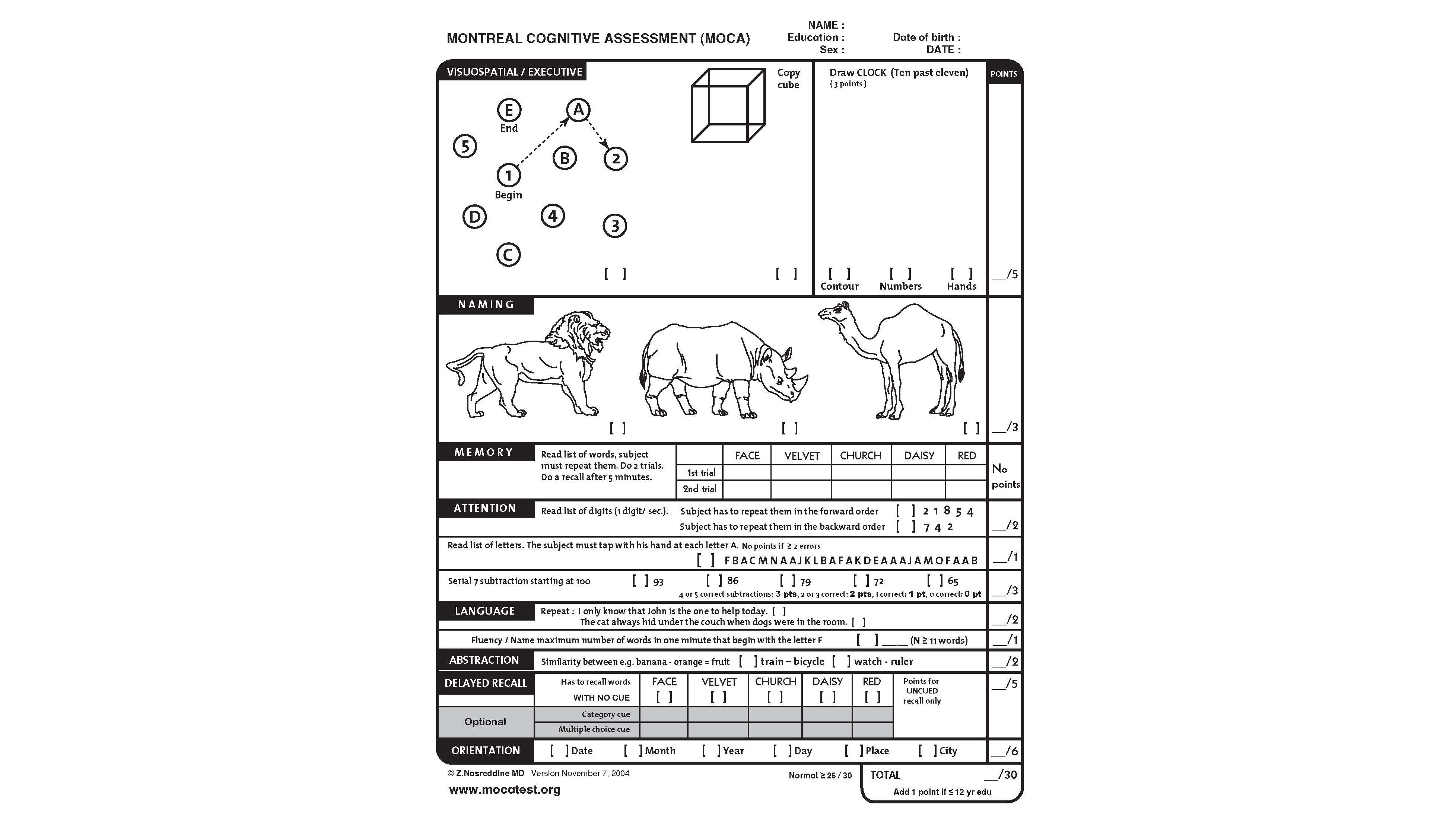
Doctors have repeatedly pushed back on Trump’s framing. CNN medical analyst Dr. Jonathan Reiner has called the MoCA a “dementia screening tool, not an IQ test,” noting that none of the questions are high-difficulty and that a perfect score reflects normal function, not “extreme intelligence.” Neurologist Dr. Vin Gupta has made the same point: the exam does not measure executive function, judgment under pressure, or fitness to hold the world’s most demanding job.
Official Health Picture From Walter Reed
The May 29, 2026, physician’s memorandum released by the White House painted a largely positive picture. Barbabella reported that Trump “remains in excellent health, demonstrating strong cardiac, pulmonary, neurological, and overall physical function.” The MoCA score was 30/30. Neurological exam findings were normal.
Some caveats appeared. The memo noted slight lower-leg swelling (improved from the previous year’s chronic venous insufficiency diagnosis), bruising on the hands consistent with frequent handshakes while taking low-dose aspirin for cardiovascular prevention, and a recommendation for continued weight management after a 14-pound gain since the prior year. An AI-enhanced electrocardiogram analysis reportedly estimated Trump’s heart age as roughly 14 years younger than his chronological age.
Trump has used these clean bills of health to attack critics and demand that every presidential and vice-presidential candidate undergo mandatory cognitive testing. “Our great country cannot be run by ‘STUPID’ or INCOMPETENT PEOPLE,” he has written more than once.

Why the Bragging Continues — and Why It Fuels Debate
Trump first took the MoCA in 2018 during his first term at his own request. He has returned to the topic constantly since 2025, often in late-night Truth Social posts or rally remarks in which he contrasts himself with Biden and challenges Democrats to take the same exam. Supporters see transparency and toughness. Critics see a president who keeps volunteering for a basic screening while treating perfect scores as proof of superior intellect.
The pattern itself has drawn scrutiny. Some physicians have questioned why a president in “excellent health” would undergo the MoCA so frequently. Screening tools are typically used when there is clinical concern or as part of routine monitoring for known risk factors. Repeated testing can also look like surveillance rather than simple reassurance.
Age remains the unavoidable backdrop. Trump turned 80 in June 2026. No previous president has served at this age. The same political media ecosystem that spent years documenting Biden’s verbal stumbles and limited public schedule now trains its attention on Trump’s late-night posting habits, occasional verbal mix-ups, and physical appearance. Trump’s response has been consistent: release selected medical summaries, demand the same tests of opponents, and declare victory on social media.

The Bigger Political Stakes
Health transparency for aging leaders has become a bipartisan flashpoint. After Biden’s visible decline contributed to his withdrawal from the 2024 race, both parties face pressure to set clearer standards. Trump has positioned himself as the candidate of openness by repeatedly publicizing cognitive scores. Opponents argue that a 10-minute screening does not answer deeper questions about stamina, decision-making, or the cumulative effects of age and stress.
Meanwhile, the July 11 post mixed the health brag with an attack on New York Times reporters Maggie Haberman and Jonathan Swan over their book Regime Change. Trump urged supporters not to buy it, calling it “garbage,” while pivoting to his medical claims. The combination of personal invective and health self-promotion has become a signature style.
For AdSense publishers and social-media traffic, stories like this perform because they combine three high-engagement elements: a polarizing political figure, genuine public curiosity about presidential fitness, and the easy shareability of “he thinks a dementia test proves he’s a genius” framing. The underlying medical reality is more mundane — a screening tool designed to catch problems, not measure brilliance — but the political theater keeps the conversation alive.
Trump shows no sign of dialing back the claims. As long as questions about his age and fitness persist, the 30-out-of-30 score will keep resurfacing, complete with animal-naming anecdotes and demands that everyone else take the same test. Whether voters treat those perfect scores as reassurance or as a distraction remains an open — and highly shareable — question.