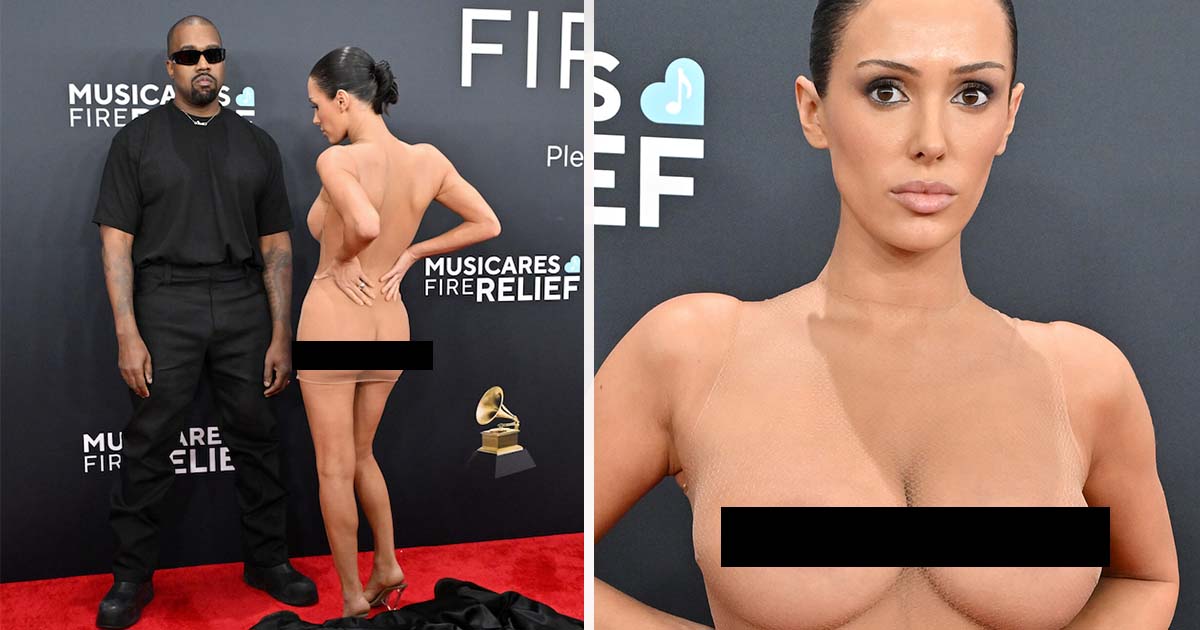
The 2025 Grammy Awards was supposed to be a monumental night celebrating the world of music—honoring artists, producers, songwriters, and industry legends for their groundbreaking contributions. From Kendrick Lamar’s historic sweep to Beyoncé’s Album of the Year win, there was no shortage of talent to spotlight. Yet, weeks later, the only thing most people remember is one shocking red carpet moment that overshadowed everything else.
Bianca Censori, Kanye West’s (Ye’s) wife, turned the prestigious event into her personal platform. By dropping her fur coat to reveal a completely sheer, near-nude transparent dress that left nothing to the imagination—front and back—she disrespected the music industry and stole the spotlight from actual nominees and winners. In my view, this kind of stunt crosses every boundary. Bianca Censori should be banned for life from the Grammys and barred from other major celebrity events.
Who Is Bianca Censori? Background and Rise to Fame
Bianca Censori, born January 5, 1995, in Melbourne, Australia, is an architectural designer, model, and entrepreneur—not a musician or performer. She holds a Bachelor’s and Master’s degree in Architecture from the University of Melbourne. Before her high-profile marriage, she worked as Head of Architecture at Ye’s Yeezy brand starting in 2020, after earlier roles in Australian firms and founding her own jewelry line, Nylons.
Her global fame exploded through her relationship with Kanye West. The couple married privately in December 2022. Censori has repeatedly made headlines for provocative public appearances, often pushing fashion boundaries in ways that generate massive buzz. While she has modeling experience, her presence at the Grammys stemmed entirely from being Ye’s plus-one—he was nominated for Best Rap Song for “Carnival.” She wasn’t a nominee or industry contributor herself.
The 2025 Grammy Red Carpet Incident
On the 2025 Grammys red carpet at Crypto.com Arena, Censori arrived in a large black fur coat alongside a stone-faced Ye. She then dramatically removed it, revealing a skintight, fully see-through “invisible dress” with no underwear. Photos and videos went viral instantly, sparking debates about decency, control in relationships, and red carpet dress codes.
The couple reportedly left early without entering the main event, fueling rumors of ejection (later denied by sources). Ye later defended the look on social media, calling it groundbreaking and claiming it made Censori “the most Googled person on Earth.” He described tailoring the dress multiple times and praised her bravery.
This wasn’t subtle fashion—it was calculated shock value that dominated headlines over musical achievements.
Fashion Evolution vs. Crossing the Line
Fashion has evolved dramatically. We’ve seen boundary-pushing moments like:
- Lady Gaga’s meat dress at the 2010 MTV VMAs.
- Rihanna’s sheer “naked dress” at the 2014 CFDA Awards.
- Jennifer Lopez’s iconic plunging Versace gown at the 2000 Grammys, which even inspired Google Images.
Celebrity fashion and red carpet controversies have always driven conversations, but there’s a limit. Public events like the Grammys involve families, global audiences, and professional standards. Indecent exposure concerns were raised, though no legal action followed from LAPD or LA DA. Grammys producers noted an “artistic black-tie” dress code interpreted loosely for guests, not performers.
Social media exploded with divided opinions: some called it empowering or artistic, others degrading and attention-seeking. Theories about Ye controlling the outfit persist, echoing past concerns about his relationships, though unproven.
Why This Matters: Role Models, Morals, and Industry Standards
Celebrities are role models in today’s social media age. With platforms amplifying every move, actions have consequences. Using a music awards show—meant for honoring talent—to promote personal buzz when you’re “just” a spouse is self-serving and disrespectful.
Censori has built a following (tens of thousands to hundreds of thousands across platforms). Parading nearly naked in front of photographers at a family-friendly broadcast event normalizes extremes. We champion self-expression, but society needs boundaries—or we accept total erosion of decency.
This isn’t about prudish “cover up” rules from the past. It’s about context, respect, and appropriateness. Award shows should enforce stricter guest policies to protect the event’s integrity.
Broader Implications for Celebrity Culture
Incidents like this fuel celebrity gossip and drive traffic, but at what cost? They distract from real achievements in music and perpetuate questions about power dynamics in high-profile relationships. Ye’s history of controversial statements and visuals adds layers.
The Grammys and similar events (Oscars, Met Gala, etc.) must draw a line. A lifetime ban for Censori would signal that some morals remain in an increasingly chaotic entertainment industry.
I’m not a “grumpy old man” longing for outdated norms. But when nude dresses and stunts eclipse talent, it’s time to ask: Has society gone too far? This Grammy moment might be the perfect catalyst to redraw that figurative line.
What do you think? Should award shows implement firmer dress codes, or is all publicity good publicity in today’s viral celebrity fashion landscape? The debate continues.