Beauty has never had just one definition. Yet for decades, fashion magazines, advertisements, and social media have promoted a narrow image of what an attractive person should look like. German model and author Ilka Brühl is helping change that narrative.
Born with a rare facial cleft that affected the development of her nose and surrounding facial features, Ilka spent much of her childhood feeling different from the people around her. She experienced painful comments, struggled with her appearance, and wondered why people who looked like her were missing from television screens and fashion magazines.
Today, her story looks remarkably different.
Through professional photography, modeling, writing, and social media, Ilka has become an advocate for self-acceptance and greater representation of people with visible differences.
Her journey isn’t simply about becoming a model. It is about discovering that a person’s value was never dependent on meeting conventional beauty standards.
1. Ilka Brühl Was Born With a Rare Facial Cleft

Image 1: Ilka Brühl has used portrait photography to celebrate her distinctive appearance. Photo source: Stern.
Ilka Brühl was born in Germany in January 1992 with a congenital facial difference involving her nose and upper lip.
Her condition, described in her own published account as a nose-and-lip facial cleft, also affected the development of her nasal passages.
Shortly after birth, she required medical attention because of breathing difficulties. Her early years involved hospital visits and surgical treatment to address complications associated with the condition.
Unlike most children, Ilka grew up familiar with medical procedures from a very young age.
The physical challenges included problems involving her nasal passages and tear duct. Yet these medical difficulties were only one part of her experience.
As she grew older, another challenge became increasingly important: learning how to live confidently in a world where people sometimes judged her appearance before getting to know her.
For Ilka, the question was never simply whether surgery could change her face. It was whether she could learn to feel comfortable with the face she had.
2. Her Childhood Was Filled With Medical Challenges and Difficult Questions

Image 2: A childhood photograph of Ilka Brühl, featured alongside her personal account in Welt.
Growing up with a visible facial difference meant that Ilka sometimes received attention she had never asked for.
Other children noticed that her face looked different. Some asked uncomfortable questions, made unkind remarks, or excluded her from activities.
The experience gradually influenced how she saw herself.
Interestingly, Ilka has explained in interviews that she does not necessarily consider herself a victim of bullying, despite encountering hurtful comments. Much of her struggle involved the negative assumptions she developed about her own appearance.
Her parents consistently supported her and reassured her that she deserved love and acceptance.
Nevertheless, encouragement from family could not completely erase her growing insecurities.
As a teenager, she began comparing herself with actresses, models, and other women presented as beautiful in popular culture.
She saw smooth skin, carefully balanced facial features, and polished portraits almost everywhere.
What she rarely saw was someone who resembled her.
That absence of representation became an important part of her journey.
3. Why Ilka Once Avoided Seeing Her Own Photographs

Image 3: An outdoor portrait of Ilka Brühl. Photo source: Wprost.
For many families, photographs preserve happy memories. But for Ilka, looking at pictures of herself was once an uncomfortable experience.
During childhood, she sometimes deliberately made exaggerated facial expressions when someone photographed her.
Her reasoning was revealing: if the photographs looked silly, her parents might be less inclined to display them around the house.
That way, she would not have to look at images that reminded her of her insecurities.
It was a small habit, but it reflected a much larger emotional struggle.
Ilka had started seeing her face through the imagined judgment of other people.
Rather than recognizing her own personality, achievements, and individuality, she often focused on the features she believed made her different.
This experience illustrates how deeply unrealistic beauty expectations can affect a person’s confidence.
The problem was not that Ilka lacked value or beauty. It was that the images surrounding her offered too few examples of beauty beyond a limited ideal.
Eventually, however, the very thing she once avoided—being photographed—would help transform her relationship with herself.
4. The Photoshoot That Changed How She Viewed Herself

Image 4: A professional portrait of Ilka Brühl. Photo source: TABI LABO.
One of the most important turning points in Ilka Brühl’s life came through photography.
Around 2014, she participated in a photoshoot after responding to an opportunity associated with photographer Ines Rehberger.
At first, the experience made her extremely nervous.
She worried about how the photographer might react to seeing her in person. Years of self-consciousness had left her uncertain about whether she belonged in front of a professional camera.
But the experience challenged those fears.
When she saw the finished portraits, she discovered something she had struggled to recognize before: she could appreciate her own appearance.
The camera did not need to erase her differences to produce a beautiful photograph.
Instead, the portraits captured her expression, personality, distinctive features, and presence.
Positive reactions encouraged her to continue exploring photography and modeling.
What began as a frightening experience gradually became an opportunity to develop confidence.
Her transformation was not instantaneous, and she has been open about the fact that learning to accept herself took time.
Nevertheless, that first photoshoot helped her understand that the negative image she had carried of herself was not necessarily how other people saw her.
5. Multiple Surgeries Taught Her an Important Lesson About Beauty

Image 5: Ilka Brühl photographed among natural foliage. Photo source: Bored Panda.
Throughout her life, Ilka underwent multiple operations related to her facial cleft.
Some procedures were necessary to address medical concerns, including problems with breathing and the structure of her nasal passages.
As she entered adulthood, she also hoped that changing certain features of her face might improve her confidence.
In a personal account published by Welt, Ilka described her expectations before a significant nasal procedure.
She had imagined that surgery might resolve not only physical difficulties but also her dissatisfaction with her appearance.
However, her experience afterward revealed something more complicated.
Changing one feature did not automatically eliminate the insecurities she had developed over many years.
She began to understand that self-confidence could not depend entirely on achieving a particular appearance.
This realization became central to her philosophy.
Medical treatment can play an essential role in improving health, comfort, and function. But emotional well-being also involves learning to recognize personal worth beyond physical appearance.
For Ilka, self-acceptance meant gradually replacing harsh self-judgment with a more compassionate understanding of herself.
Instead of constantly searching for another feature to change, she began appreciating the person she already was.
6. How Ilka Brühl’s Modeling Career Challenges Traditional Beauty Standards
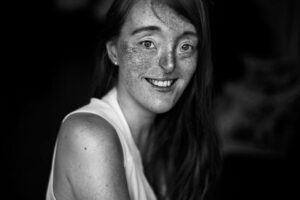
Image 6: Black-and-white portrait of Ilka Brühl. Photo source: Neues Leben.
As Ilka became more comfortable in front of the camera, she began sharing her modeling photographs with a wider audience.
Her portraits attracted attention because they challenged conventional assumptions about who could be considered beautiful.
Rather than hiding her facial difference, Ilka allowed it to remain visible.
This approach distinguished her photographs from an industry often associated with retouching, flawless skin, and tightly controlled visual standards.
Her modeling work became closely connected to a broader message: people should not have to change their natural features to deserve visibility and respect.
Ilka’s participation in photography projects and her social media presence helped introduce her story to people far beyond Germany.
She also became associated with Project Grenzenlos, a photography initiative highlighting individuals with visible differences and encouraging broader ideas about beauty.
The message resonated because it addressed something many people experience, even without a congenital facial condition.
Almost everyone has felt insecure about some aspect of their appearance.
For some, it may involve skin texture, height, weight, scars, or aging. For others, it may involve a physical difference that attracts unwanted attention.
Ilka’s photographs encourage viewers to reconsider why certain appearances are treated as acceptable while others are overlooked.
Her work also raises an important question for fashion and advertising companies.
If consumers come from countless backgrounds and have countless different appearances, why shouldn’t advertising reflect that diversity?
7. Beyond Modeling: Ilka Brühl Became an Author and Advocate

Image 7: Ilka Brühl presents her book, Anders schön. Photo source: Bremen Zwei.
Modeling is only one aspect of Ilka’s professional life.
She also studied mechanical engineering and has worked as an author and illustrator.
Her personal experiences eventually inspired her to write a book titled Anders schön: Wie ich lernte, mich selbst zu lieben.
The German title can be translated as Beautiful in a Different Way: How I Learned to Love Myself.
Published by Patmos, the book explores her experiences growing up with a facial difference, struggling with self-confidence, and gradually developing a healthier relationship with her appearance.
Rather than presenting self-love as a simple decision, the book acknowledges that acceptance can be a long and sometimes difficult process.
Ilka has also used blogging, podcasting, and social media to discuss confidence and representation.
Her work addresses an audience that extends beyond people with facial differences.
It speaks to anyone who has ever felt inadequate because of unrealistic expectations.
Her message is particularly relevant in an era when digital filters, image-editing applications, and carefully curated online profiles can make ordinary appearances seem imperfect.
By sharing personal experiences instead of presenting an artificially flawless image, Ilka encourages more authentic conversations about beauty.
8. Ilka Brühl’s Personal Life: Finding Love and Happiness
Ilka’s story also includes important developments outside her professional work.
She married her longtime partner, Philip, and has shared reflections about the happiness surrounding their wedding.
According to a report by Newsner, she described the occasion as an emotional and memorable experience.
Her marriage represents another meaningful chapter in her journey toward greater confidence.
During her teenage years, Ilka struggled with doubts about whether others would find her attractive or accept her appearance.
Those fears, however, did not determine the course of her adult life.
Her relationship and marriage illustrate an important distinction: appearance is only one aspect of a person, while meaningful relationships depend on many other qualities, including trust, affection, shared experiences, and compatibility.
Ilka’s personal happiness is not proof that everyone must find a romantic partner to feel complete.
Instead, it adds another dimension to a story about gradually overcoming limiting beliefs.
9. What Makes Ilka Brühl’s Story So Important Today?
Ilka Brühl’s journey is significant because it challenges attitudes that affect millions of people.
Traditional beauty standards have often treated differences as features that should be concealed or corrected.
But a more inclusive understanding of beauty recognizes that human appearance is naturally varied.
Facial differences are not personal failures.
Scars, asymmetry, birthmarks, and other visible characteristics do not determine someone’s intelligence, personality, abilities, or potential.
According to the U.S. Centers for Disease Control and Prevention, cleft lip and cleft palate are congenital conditions that can require specialized medical treatment. The healthcare needs of affected individuals vary considerably.
Understanding such conditions is important, but medical information tells only part of the story.
People with visible differences also deserve opportunities to participate fully in education, employment, entertainment, and other aspects of society without facing unnecessary prejudice.
That includes the fashion industry.
Models such as Ilka demonstrate why representation matters. Seeing a wider range of faces in advertisements and editorial photography can help challenge the assumption that beauty belongs to only one type of person.
At the same time, her experience shows that confidence is not about feeling beautiful every minute of every day.
It is also about being able to participate in life without allowing insecurity to control every decision.
10. The Lessons We Can Learn From Ilka Brühl’s Journey
There are several meaningful lessons in Ilka’s experience.
First, self-acceptance takes time. Years of negative self-perception rarely disappear after one encouraging conversation or a single positive experience.
Second, representation matters. When people see others with similar appearances achieving their goals, it can broaden their understanding of what is possible.
Third, confidence can grow through action. Ilka did not begin modeling because she had completely overcome her insecurities. Participating in photography helped her challenge them.
Finally, beauty should never be used as a measure of human worth.
Someone does not have to be conventionally attractive, photogenic, or admired online to deserve respect.
That distinction is especially important for children and teenagers growing up surrounded by highly edited digital images.
A more compassionate society begins by recognizing individuality rather than treating differences as flaws.
Frequently Asked Questions About Ilka Brühl
What condition was Ilka Brühl born with?
Ilka Brühl was born with a congenital nose-and-lip facial cleft that affected the development of parts of her face and nasal airways. Her own published account describes the condition as a facial cleft.
How did Ilka Brühl become a model?
Her modeling journey developed after she participated in a professional photoshoot around 2014. Seeing the resulting portraits and receiving encouraging feedback helped her become more comfortable with photography.
Did Ilka Brühl undergo surgery?
Yes. Ilka underwent multiple medical procedures throughout her life, including operations related to her nasal passages and facial structure. She has spoken openly about how these experiences influenced her understanding of beauty and self-confidence.
Is Ilka Brühl married?
Yes. Ilka married her longtime partner, Philip. She has discussed the happiness and emotions she experienced around their wedding.
What book did Ilka Brühl write?
She wrote Anders schön: Wie ich lernte, mich selbst zu lieben, a memoir about living with a facial difference and learning to appreciate herself.
Where can readers follow Ilka Brühl?
Readers can find her on Instagram at @ilkabruehl, where she has shared photography, personal experiences, and messages about acceptance.
Final Thoughts: Beauty Has More Than One Face
Ilka Brühl’s story began with medical challenges and years of uncertainty about her appearance.
But her journey did not end with insecurity.
Through photography, writing, and public advocacy, she discovered ways to embrace her individuality and encourage others to reconsider their own ideas about beauty.
Her experience reminds us that confidence is not necessarily the result of changing how we look.
Sometimes, it begins when we change the way we see ourselves.