Some faces stop a scroll. Yazemeenah Rossi’s does it twice: first because of the silver hair and the unforced smile, then again when the caption reveals the date of birth. Born 21 December 1955 on Corsica, she has spent more than a decade being called the “world’s most beautiful grandmother.” The phrase is a media nickname, not an official crown, but it stuck because the photographs kept arriving and the age kept climbing.
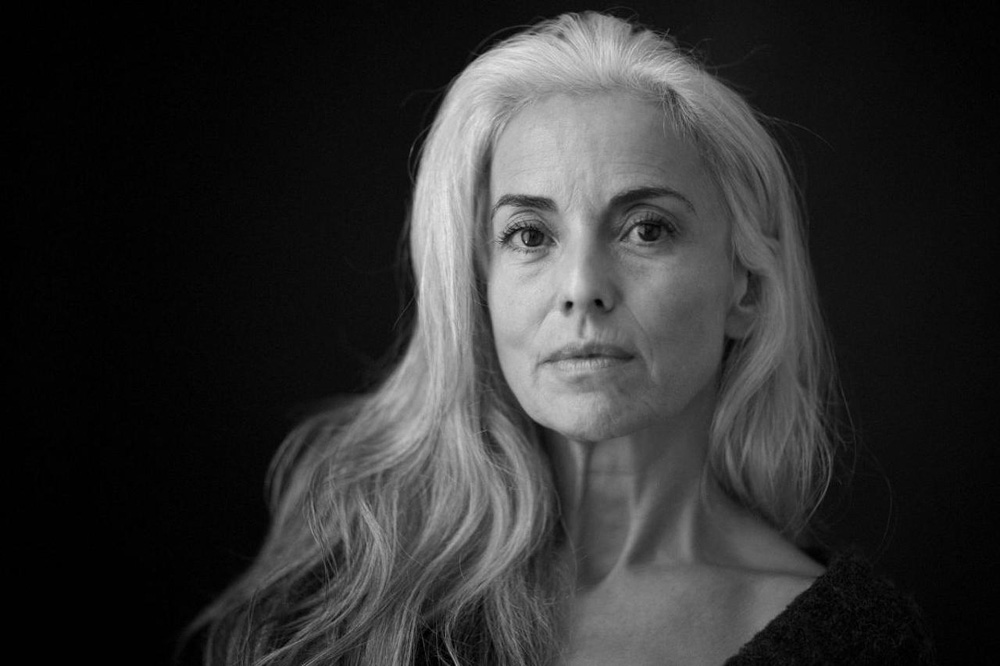
By late 2026 she is 70. The nickname still follows her. So does the work. Rossi is a French-American model, photographer, designer and grandmother who entered fashion at the age when most models are told they are finished. She never dyed the hair that started turning at eleven. She has said she has not had cosmetic surgery. She still poses, still hikes, still knits, still talks about aging as something that can make a person stronger rather than smaller.
That combination — late start, silver hair, visible age, visible vitality — is why her story keeps being rewritten every few years. The facts underneath the headline are more interesting than the headline.
A childhood by the water, without electricity
Rossi did not grow up in a fashion capital. She spent her early years with her grandparents near Favone, on Corsica’s east coast, in a household without running water or electricity. Her grandparents ran a small beach restaurant. She has described washing in the river, a grandfather’s garden of fruit and vegetables, and a grandmother who carried water in a pot on her head and lived to 96 with “a body of a ballerina.”
That landscape trained her eye before any agency ever did. At eleven she received a camera. Light on water, salt on rock, the long Corsican afternoon — those became the first subjects. Years later, after she had moved between France, New York and Malibu, she would still talk about the sea as the thread between her two homes. In Malibu, she once asked a Native American speaker what “Yazemeenah” meant. The answer she received — “bowl of salt” — felt, to her, like a private joke the universe had been waiting to tell.
She later changed the spelling of her given name, Yasmina, so it looked the way her grandmother had pronounced it. The two names refer to the same woman.

Mother of two before the first booking
The modeling story is often told as if it began in a Paris fitting room. The life before that booking is harder, and more typical of many women’s lives than of the fashion industry’s myth of the teenage discovery.
Rossi has said she was a mother of two by twenty. She worked from home — clothes, knitting, interior work for friends and private clients — and refused the idea of an office desk or a single address for life. “I knew since teen that I would never work in an office or stay at the same place through all my life, so even at the time when raising my children I was very active and independent,” she said in 2020.
Earlier interviews fill in the sharper edges. She became pregnant at sixteen, married, later divorced, and rebuilt a life around work and the children rather than around a conventional career ladder. Modeling was not the plan. Independence was.
The accidental model who started at retirement age
Her first job in front of a camera was a substitution. In Paris, her sister — who worked in fashion retail — asked her to stand in when a model failed to appear during Fashion Week. Rossi was about 28. She had never modeled. She said yes.
What followed was not an overnight cover girl arc. She spent years as a fittings model for houses including Hermès and Yves Saint Laurent, the unglamorous work of standing still while clothes are pinned and adjusted. Only later did she move into print. Around the turn of the millennium she went to New York, signed with Ford Models, and appeared in campaigns and catalogues for names such as Bloomingdale’s, Barneys, J.Crew and Bobbi Brown. Japanese retailer Isetan also used her in work that put an older face — and already silver hair — in front of shoppers who were not used to seeing either.
The industry’s usual clock was running the other way. Most models are recruited in their teens and quietly dropped in their late twenties. Rossi started after 30 and kept going. “My career began at an age when others are thinking about retiring,” she has said. That sentence is the whole argument of her public life.
She has also acted, with credits listed in profiles for titles including Timeless Beauty, Relevator and The Grasslands. Modeling, though, is the through-line: catalogues, commercials, magazine covers, diversity campaigns aimed at women over 50, and later the swimwear pictures that made the grandmother nickname travel.
Silver hair as a career, not a concession
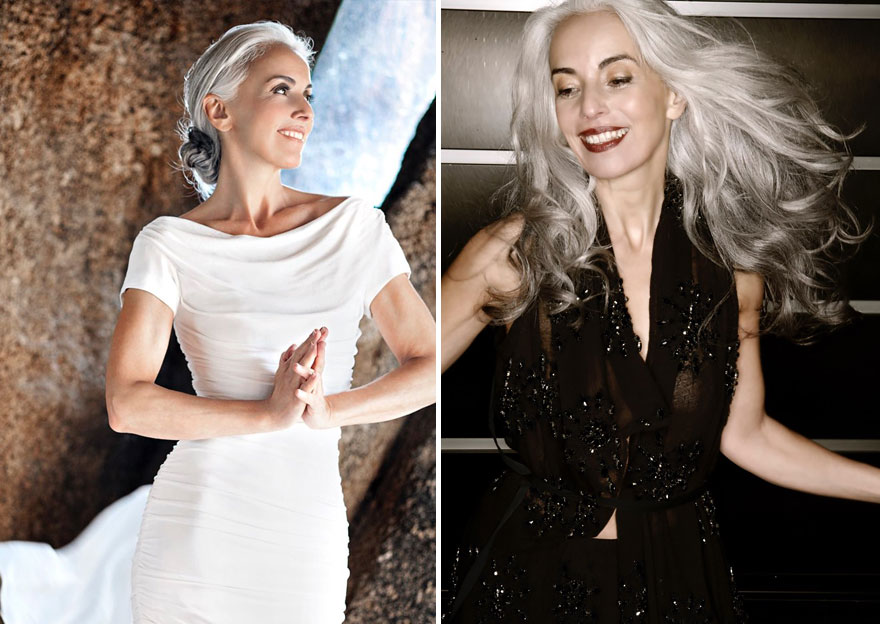
Rossi’s first grey strand appeared at eleven. She never dyed it. By her late twenties the hair was already salt-and-pepper; by midlife it was a long silver sheet that photographers could light like metal. In the 1980s, she has said, she was one of a tiny number of working models with naturally white or silver hair.
That choice later became a movement she did not invent but helped make visible. Grey-hair campaigns, “pro-age” editorials, unretouched older faces — all of that arrived after she had already been walking around looking like that in ordinary rooms. “I’m passionate about what I’m doing. I have no time [to dye my hair]. It’s beautiful. It’s silver,” she told The Guardian.
The hair is also a refusal. Fashion houses and advertisers have long paid women to look younger than they are. Rossi’s look does the opposite: it advertises the years. That is why the same photographs keep being recirculated with new ages in the headline. The face does not reset. The caption has to.
The swimwear pictures that made the nickname stick
The phrase “world’s most beautiful grandmother” exploded after a mid-2010s wave of images, especially a 2016 swimwear campaign for Land of Women / The Dreslyn. Rossi had sent the designers self-portraits in lingerie. They booked her and, crucially, did not sand the pictures into a younger woman’s body. Wrinkles, joints, silver hair, a swimsuit: the combination felt, to a large online audience, like a correction.
Colleagues called the swimwear work “courageous.” Her answer was dry. “This is not courage. This is simply who I am. If more models are authentic, it will impact people who see them.”
There is no pageant that awarded the grandmother title. Reputable coverage treats it as a viral label that attached itself after those pictures and has been reused ever since. That does not make the reaction fake. It means the public, not a jury, did the crowning.

She has continued to model in the years since, including work that would once have been reserved for women half her age. Asked about stopping, she has been consistent. “I will model until the end of my life,” she told the Daily Mail. Then she added the line that explains the rest: “But it’s not about modeling, it’s about witnessing, witnessing beauty, energy makes us alive.”
What she actually does for her skin and body
People who see the photographs often assume a surgeon’s hand. Rossi has answered that question for years. “I haven’t had any cosmetic surgery so far. The idea of going under the knife when I am perfectly healthy doesn’t make much sense to me.”
Her described routine is almost aggressively ordinary:
- oil on the skin
- rapeseed oil in the hair
- a weekly scrub of olive oil and fine sugar
- an avocado a day
- organic meat and fish, and more recently a mostly seasonal, local, largely vegetarian plate
- organic body and hair products
- yoga, local hiking, and a stationary bike used as a workstation at home
She has also spoken of dropping processed food, sugary drinks and regular alcohol after menopause, and of a morning habit of warm water with lemon in some interviews. None of this is a patented protocol. She has said there are no “magic tricks,” only a playful, curious temperament and the decision not to fight every visible year.
“Age is definitely a state of mind. If you are connected with your inner child, you can recharge your batteries and keep that energy. You need to have a playful, adventurous, curious spirit.”
That last point matters more than the avocado. Plenty of people eat well and still look exhausted. Rossi’s public argument is that curiosity is a cosmetic.

Malibu light, Corsican memory
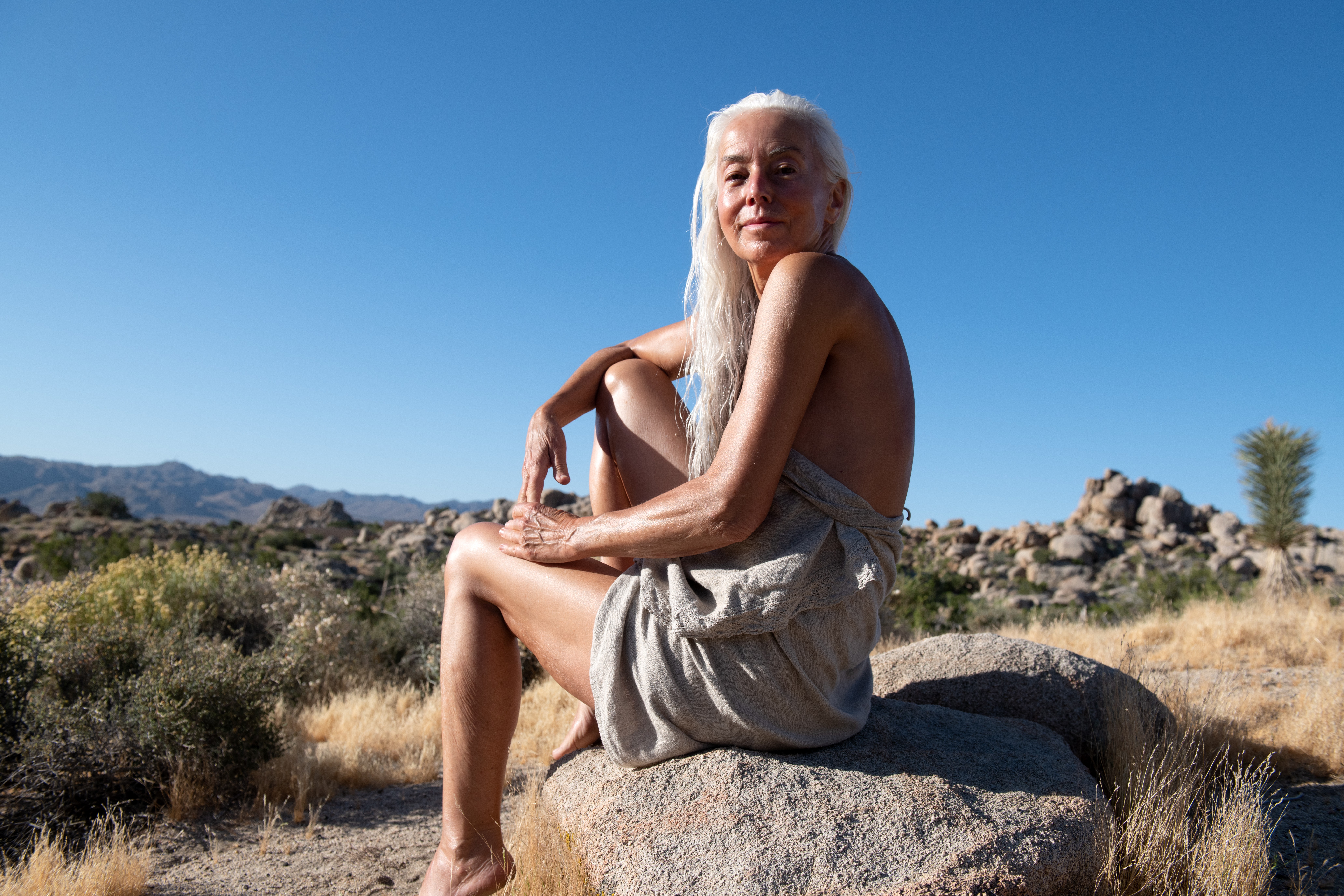
She holds dual French and American citizenship and has lived for years in Malibu, California, while returning to Corsica and Paris. The California house, in older profiles, is described as a place of rocks, crystals, meditation music and no television — a studio as much as a home. She photographs in natural outdoor light when she can. Sunsets interrupt interviews. A hike is not content strategy; it is how the day is built.
Height is listed around 5’8″ (about 172–175 cm depending on the agency card). Measurements on model boards put her in the classic commercial range, but the selling point is not a number. It is the combination of a trained body and an unedited face.
She is not married. She has a son, a daughter, and two grandchildren. The grandmother nickname is therefore literal, not decorative. Early profiles named the granddaughters and their ages as they grew; she has generally kept family life off the runway and on the private side of the lens.
Artist first, model when the light is right
Calling Rossi only a model flattens the rest of the work. She is a self-taught fine-art photographer whose pictures and videos lean toward the meditative: landscapes, still lifes, self-portraits, fabric in wind. She works in pottery, jewelry and fiber arts. In recent years the most visible craft has been oversized cashmere shawls, shot on her own body, sold from her site, with a portion of sales directed to Docs Foundation Nepal, a small orphanage in Kathmandu. That is the “social entrepreneur” line on her own biography: wearable work that pays artisans and sends money to children she will never meet on a booking.
The same woman who fills in on a commercial set will also stand behind the camera, style the frame, and post the result without a publicist’s filter. Instagram and Facebook became her gallery when magazines still treated older women as a niche. Followers accumulated after a 2015 wave of blog posts; the audience now spans teenagers who write to her about aging and women her own age who write to say they stopped dyeing their hair.
What the industry still has not learned
Rossi is clear-eyed about fashion’s limits. “There was a time, some years ago, when I started to think things would gradually begin to change and we’d start to see more older models, but that did not happen,” she told Vice. Men and women, she said, share the same fear of gravity; men simply discuss it less. Growing older, in her telling, is still “something beautiful because you become stronger with the passing of time.”
The market has moved a few inches. “Silver sister” campaigns exist. Diversity briefs sometimes include age. Rossi’s own bookings prove that a 60- or 70-year-old woman can sell a swimsuit without being turned into a joke or a medical miracle. The default face in advertising is still young. She has never pretended otherwise. She has simply refused to leave the frame.
In The Guardian she compressed the philosophy into four words that work as well at 70 as they did at 60: “Sexy means alive. I’m alive.”
Why the story keeps returning
Every few years a site republishes the same arc with a new age in the headline: 60, 63, 64, 66, 67, 69, 70. The source article behind this piece followed that pattern, updating a 2020 story into a 69-year-old frame. The reason the piece works is not the number. It is the accumulation.
A girl on a Corsican beach without electricity becomes a teenage mother, then a fittings model, then a New York booking, then a silver-haired face on a Japanese catalogue, then a grandmother in a bikini that the internet cannot stop forwarding. Along the way she knits, photographs, sells shawls, sends money to Nepal, hikes the local trail, oils her hair, and declines the knife.
That is not a beauty secret. It is a long argument, lived in public, that a woman’s capital is not only her youth. “Take advantage of how you are. Do not destroy your capital,” she has said. The capital, in her case, is the face that time actually made — and the energy she still brings to the set.
She has already said she will keep modeling until the end of her life. The more useful line is the one that follows it. The job, as she defines it, is not to look twenty. It is to keep witnessing beauty, and to stay alive enough to show it.