In September 2001, volunteer firefighter Patrick Hardison ran into a burning house in Senatobia, Mississippi, looking for a woman he believed was trapped inside. The roof collapsed. His mask melted to his face. His hose melted in his hands. He crawled out a window with his head and upper body on fire.
He lived. For 14 years after that, living was the harder part.
Today — more than a decade after surgeons at NYU Langone gave him a new face, scalp, eyelids, ears, and nose — Hardison is a grandfather, a published author, and still the same plain-spoken Mississippi first responder at heart. The journey between those two lives is one of the most extraordinary stories in modern reconstructive medicine.
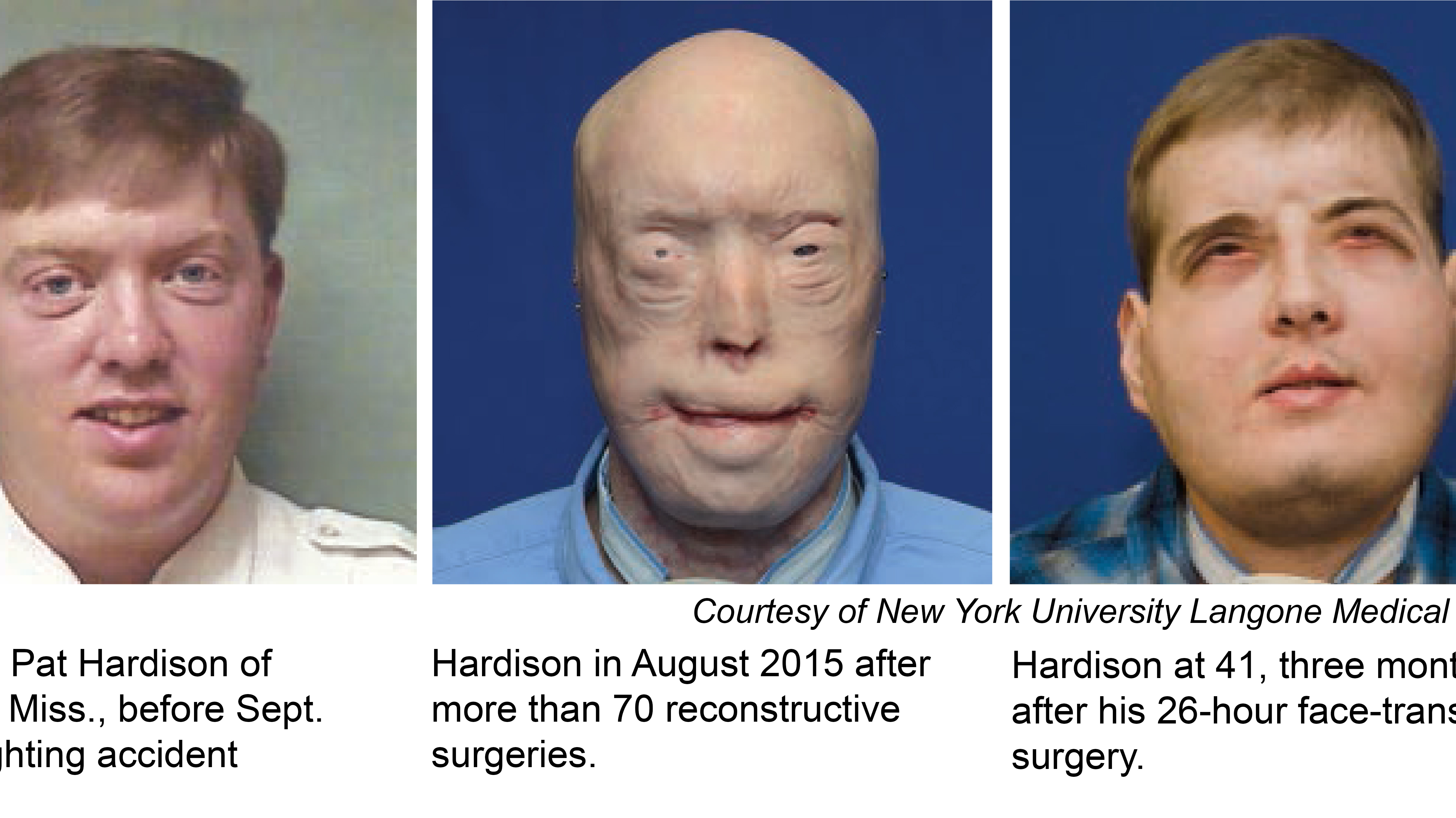
A house fire that took a face — but not a life
Hardison was 27, a father, and a seven-year volunteer with his local department when the call came on September 5, 2001. The search was based on a mistake: no one was trapped. The structure failed anyway. Friend and fellow first responder Jimmy Neal later said he had never seen anyone burned that badly who was still alive.
The fire destroyed Hardison’s ears, lips, most of his nose, almost all of his eyelid tissue, his scalp, and his eyebrows. Third-degree burns covered his face, neck, and upper torso. He was still in a medically induced coma when the September 11 attacks happened a week later.
When he finally saw himself months later, surgeons had cut a pinhole in one eyelid so he could look through the grafts. “I looked in the mirror and all I could do, I said, ‘this is it? I can’t do this,’” he later told Fox News.
Seventy-one surgeries and a life lived behind sunglasses
Over the next 14 years Hardison underwent 71 reconstructive procedures. None of them restored a working face. He could not form normal expressions. Eating and laughing hurt. He could not blink or fully close his eyes. Flaps of skin were sewn together to protect his vision, but he was still at risk of slowly going blind.
In public he wore a baseball cap, sunglasses, and prosthetic ears. Children ran from him at ball fields. Parents whispered. “You go to the ball field, you have to prepare yourself for the kid that goes running off screaming,” he said. There was no day off from the injury.
He stayed for his five children. His eldest daughter Alison later recalled him saying he wanted to look normal enough to walk her down the aisle. That hope, more than vanity, is what kept him searching for something beyond another skin graft.
The operation no one had done at this scale
Face transplants have existed since 2005, when France’s Isabelle Dinoire became the first recipient. By 2015 they were still rare, extremely risky, and never attempted at the scale Hardison needed: full face and scalp, eyelids that could blink, ears and ear canals, and bone from the chin, cheeks, and entire nose.
Dr. Eduardo D. Rodriguez at NYU Langone Medical Center had performed a face transplant before. Hardison, he later said, was “the ideal patient” — motivated, medically suitable, and facing a problem conventional reconstruction could not solve. The matching process took more than a year. Two potential donors fell through. Then LiveOnNY found a match.
Doctors warned Hardison he had about a 50/50 chance of surviving the surgery. He accepted it. “There are things in life that are worse than dying,” he said. “I’ve known that for 14 years.”

A 26-year-old cyclist and a mother’s decision
The donor was David Rodebaugh, a 26-year-old Brooklyn bike mechanic and BMX rider. On August 12, 2015, after a cycling accident, he was declared brain-dead. His mother, Nancy Millar, donated his heart, liver, kidneys — and his face.
“I said, ‘You better save his face. He has the face of a porcelain doll.’ And he’s a donor — we had talked about it,” Millar told People. She did not hesitate. She wanted her son to live on. Through LiveOnNY, Rodebaugh’s tissue profile, blood type, skeletal shape, and coloring aligned with Hardison’s needs.
Two days later, on August 14, 2015, two surgical teams began working in adjoining operating rooms.
Twenty-six hours and more than 100 people
The procedure started in the early morning and ended just under 26 hours later, on August 15. More than 100 physicians, nurses, and technicians took part. Surgeons lifted Hardison’s scarred skin “as if pulling off a ski mask,” then transferred a composite graft of skin, muscle, nerves, blood vessels, scalp, eyelids, ears, and selected facial bones. Three-dimensional printed cutting guides helped tailor the donor skeleton. Microvascular connections had to hold. A suture failure on an internal jugular vein caused a dangerous bleed that the team repaired mid-operation. The new face swelled to about 50 percent larger than normal.
It was, Rodriguez said, the most extensive face transplant ever performed. “No one had ever replaced this quantity of tissue before. There was no medical experience to show it was possible.”
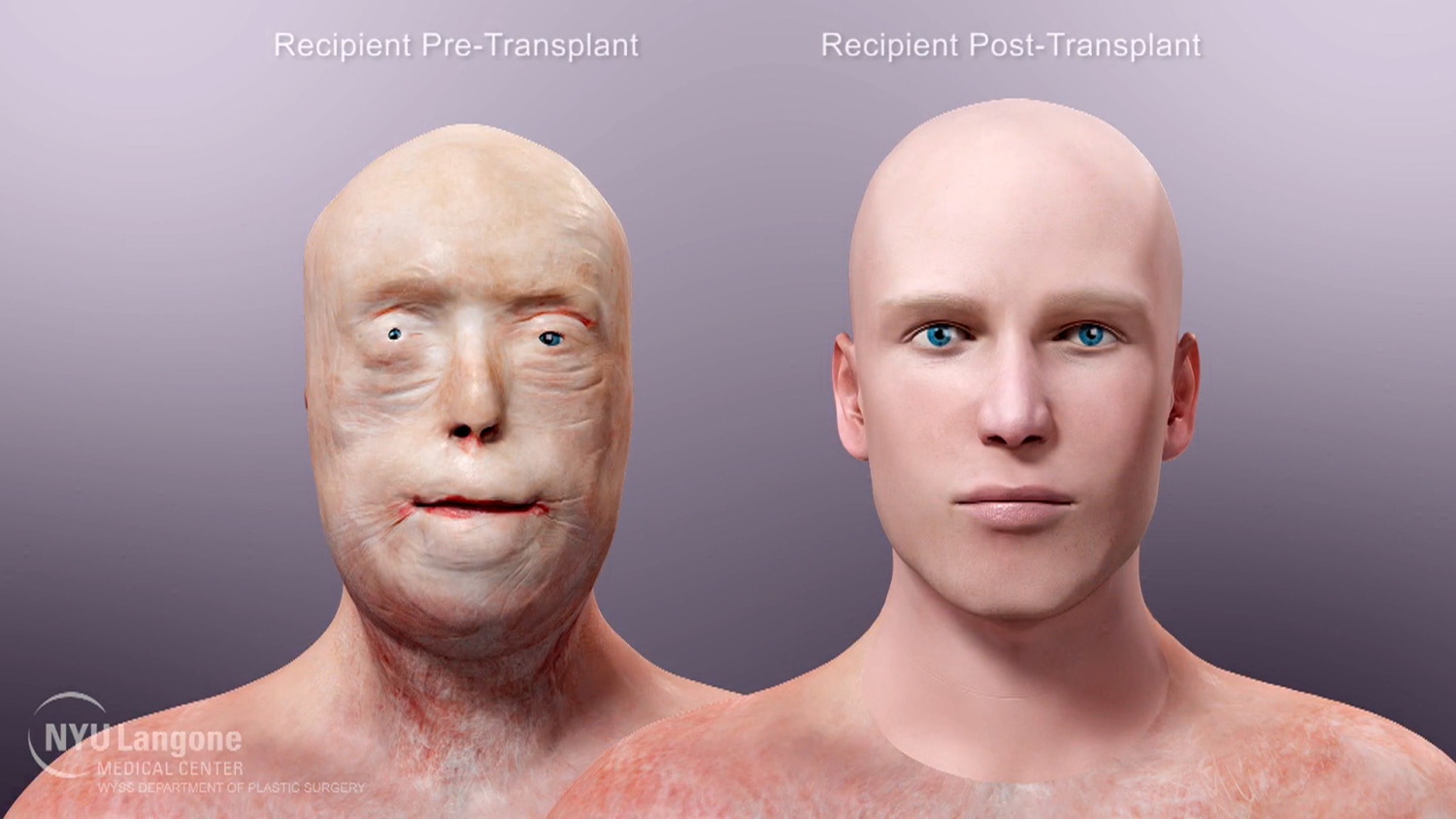
The first blink in 14 years
Hardison blinked on day three, once the swelling began to fall. That single function mattered more than appearance. Without eyelids, his eyes had been drying toward blindness. With them, he could sleep, keep his eyes clean, and eventually drive again.
The first week was brutal: blood-pressure swings, an unstable airway, a mouth that would not close because of swelling. He had to relearn how to swallow and speak. He would take immunosuppressant drugs for the rest of his life. Rituximab was added to the regimen — a first in face transplantation — in an effort to reduce rejection risk.
By early October he was holding conversations and eating solid food. On a trip to Macy’s after discharge, no one stared. “I could tell the difference right then,” he told People. “Nobody was staring, nobody was saying anything. I was just there.”
He returned to Senatobia in time for Thanksgiving. Fire trucks honked. A parade rolled through town. Nine weeks after surgery his children walked into his hospital room; he hugged them and wiped tears from under eyelids that finally worked.
One year later: “Just a normal guy”
At the one-year mark, Rodriguez reported that Hardison could form a full range of expressions, chew without pain, and speak clearly. He had not had a rejection episode. Feeding and breathing tubes came out earlier than expected. That June the family went to Disney World. Hardison swam in the pool — something he had not done in 15 years.
In November 2016 he met Nancy Millar in New York. She asked to kiss his forehead, the way she had kissed David’s every night when he was little. “It’s not David’s face, it’s your face,” she told him. “I am as proud of you as I was of my own son.” Hardison said it felt like family. Millar also met other recipients of her son’s organs that day.
Eleven years later: grandbabies, a book, and a treated rejection
The face Hardison wears in 2026 is not a frozen snapshot of 2015. Swelling subsided over months and years. Revision surgeries adjusted eyelids, lips, forehead, chin, and ears. The transplanted tissue aged with him. Around year eight he developed rejection issues and returned to New York for treatment. He has continued to do well.
In 2025 he published a memoir, Facing the Fire, with Rose and Pearl Publishing. He was 51 then. He told interviewers he has “beautiful grandbabies now, and basically no restrictions, doing everything I want.” He still talks like a firefighter — direct, task-oriented, uninterested in being a medical curiosity. Writing the book, he said, was harder than the surgeries. He hoped it would offer “hope for people struggling in everyday life.”

Recent interviews show a man in a ball cap and polo shirt, speaking from a Mississippi kitchen with family photos behind him. The scars of both the fire and the transplant are visible. So is the fact that he can sit in public, go out in the sun, and live without the daily armor of sunglasses and prosthetics.
He has described the years after the fire as anger and isolation, and the years after the transplant as a second assignment: stay alive, take the medicine, tell the story so someone else does not give up. “God has kept me on this earth this long to get this transplant, so that I can inspire others, so that I can give them hope,” he said in an earlier reflection.
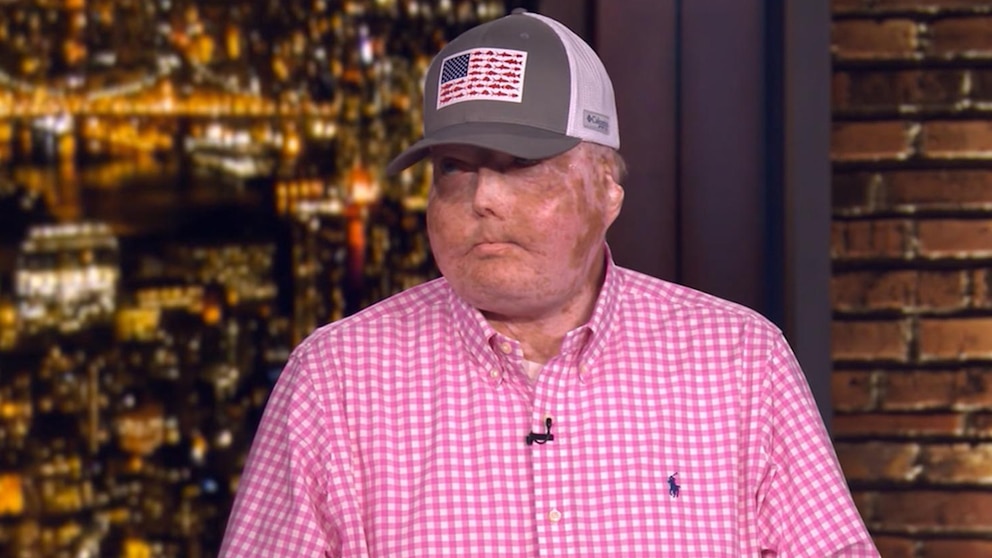
What this surgery actually restored
It is easy to treat a face transplant as a before-and-after photo. For Hardison the functional list mattered more:
- Eyelids that blink and close, ending the march toward blindness
- The ability to eat and laugh without constant pain
- Speech and swallowing rebuilt after the graft
- A public life without children fleeing and strangers pointing
- The ordinary errand — a store, a ball field, a pool — that had been impossible
Rodriguez has always been careful about who this operation is for. “This is not an operation for everyone. It’s for very courageous people.” Recipients face lifelong immunosuppression, revision surgeries, and the possibility of rejection years later. Hardison’s case is notable not only for the amount of tissue transferred, but for how long the graft has held and how fully function returned.
None of it happens without a donor family. Rodebaugh’s heart, kidneys, and face went to multiple people. Millar’s decision is the hinge of the entire story. Hardison has said he prays for that family and hopes they see something good in the life that followed.
The man in the photos is still Pat
Viral headlines flatten this into “look at him now.” The real arc is slower: a volunteer who went through a door, a father who hid his face so his kids could have a public life, a patient who accepted a coin-flip surgery, a recipient who did the unglamorous work of rehab and pills for more than a decade, and a grandfather who wrote a book because the surgeries were not the last thing he had to face.
Eleven years after the 26-hour operation, Patrick Hardison does not look like the young firefighter in the 2001 photo. He also does not look like the man in the blue hospital shirt after 71 failed reconstructions. He looks like someone who survived both the fire and the operating room — and then kept showing up.
That is the part the pictures cannot fully show. The rest is in the blink, the swim, the ball field, and the grandbabies who never knew the version of him that made other children run.