The photos were never supposed to be the story. President Donald Trump was in Davos to launch a U.S.-backed “Board of Peace,” sign documents, and talk tariffs and geopolitics. Instead, cameras locked onto something smaller and far more human: a dark, spreading bruise on the back of his left hand.
Within hours, the mark had its own life on social media. Was it an IV site? A fall? A hidden medical procedure? The White House and Trump himself answered with a much simpler line: he clipped his hand on a table.
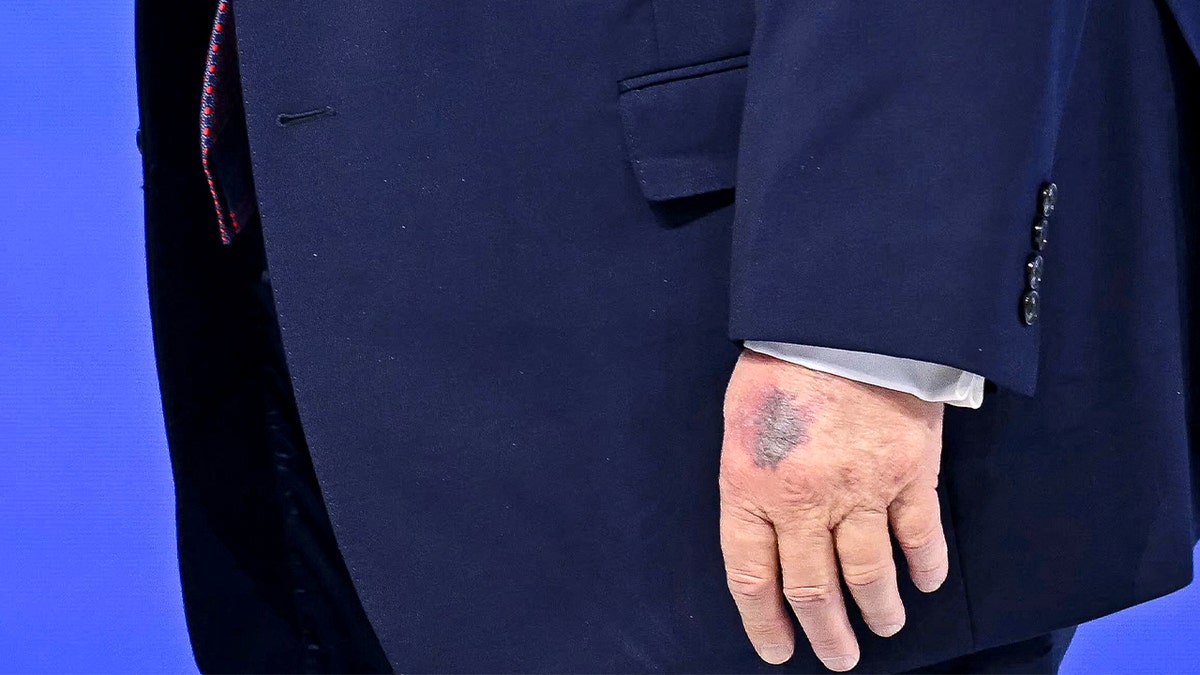
That close-up, taken during the January 22, 2026 signing ceremony at the World Economic Forum, is what set the conversation off. The discoloration is not a faint smudge. It is a heavy, bluish-purple patch across the back of the left hand — the hand that had usually been the “clean” one. For months, it was Trump’s right hand that drew the questions, the makeup, and the bandages. This time the mark was on the other side.
A peace-board signing that became a photo-op for a bruise
The setting mattered. Trump was at a formal ceremony for the Board of Peace, a U.S.-backed body meant to help administer a fragile Gaza ceasefire after the Israel-Hamas war. Leaders stood behind a white table. Documents were signed. Photographers crowded the front row. And then the pictures of the hand started circulating.

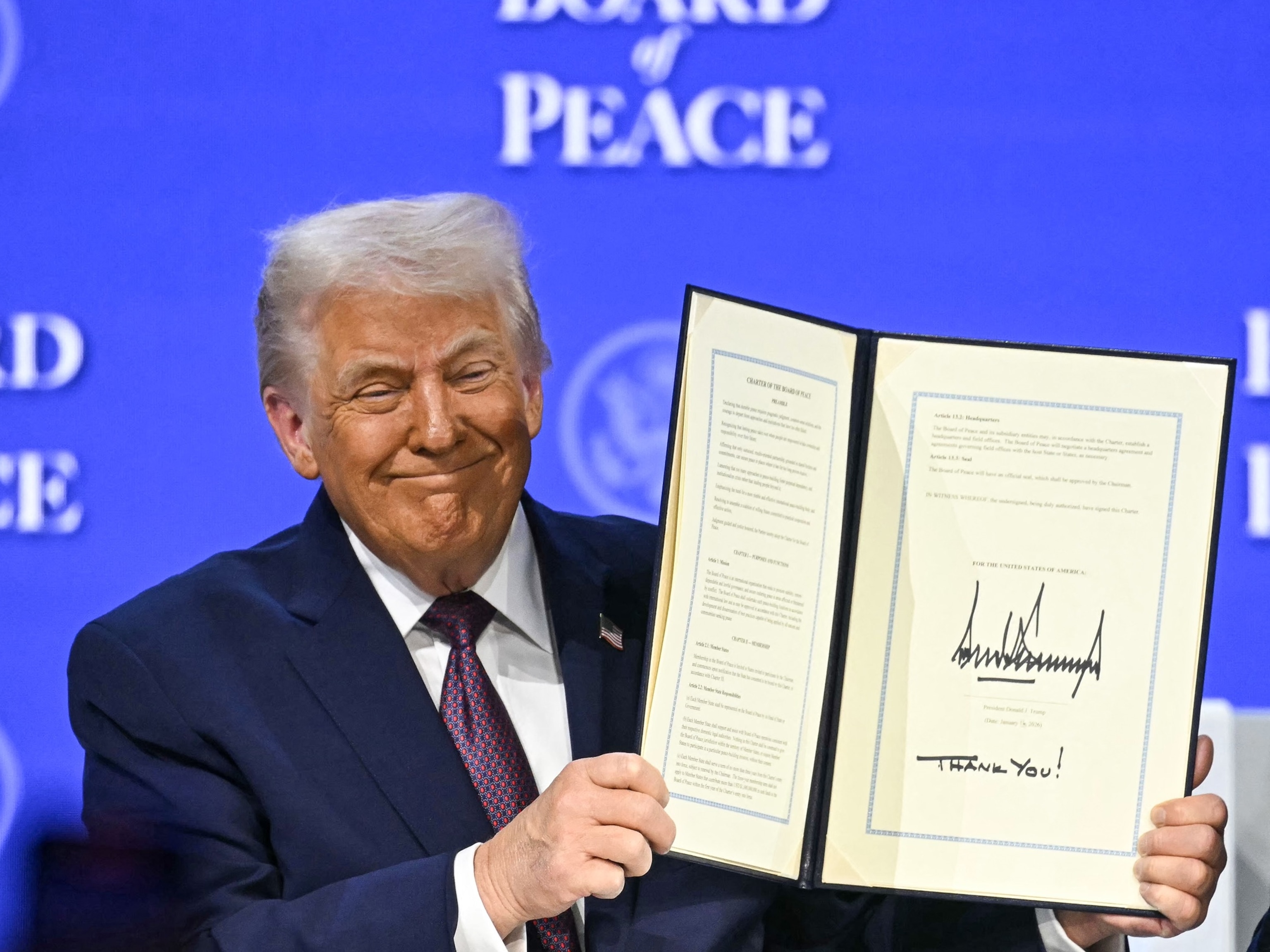
White House officials later insisted the bruise was not there at the start of the event. Photos from the previous day and from earlier that morning, they said, showed a clean left hand. The mark appeared after Trump sat at the signing table. Press secretary Karoline Leavitt put it in a statement: at the Board of Peace event in Davos, the president hit his hand on the corner of the signing table, and that is what caused the bruise.
A White House official added another detail that would become central to every follow-up story: Trump bruises more easily because he takes a daily aspirin. That fact had already been disclosed by his doctors. Officials also stressed that the bruise was new that day, not an old injury that cameras had suddenly noticed.
“I clipped it on the table”
Trump did not wait for the press office to carry the entire explanation. On the flight home aboard Air Force One, a reporter asked the obvious question: we saw the bruising on your hand. Are you okay?
“I’m very good,” he said. Then came the line that became the headline.
“I clipped it on the table. So I put a little — what do they call it? — cream on it. But I clipped it.”
He immediately tied the appearance of the mark to medication. “I would say, take aspirin if you like your heart, but don’t take aspirin if you don’t want to have a little bruising,” he told CNN’s Samantha Waldenberg. “I take the big aspirin, and when you take the big aspirin, they tell you, you bruise. The doctor said, ‘You don’t have to take that, sir, you’re very healthy.’ I said, ‘I’m not taking any chances.’”

That is classic Trump: a short physical explanation, a medical aside, and a refusal to treat the bruise as a crisis. He applied cream. He said he felt fine. He kept talking about aspirin as if the side effect were almost a badge of seriousness about his heart.
The White House line, in one sentence
Leavitt’s version matched his. The bruise was an accident at the signing table. Aspirin made the discoloration more visible. Pictures from earlier in the trip showed no mark on that hand. The message was consistent: this is not a new illness, not a secret procedure, and not a reason to rewrite the president’s health file.
The timing of the official comments mattered. Speculation was already running. A bruise that large, on a 79-year-old president, in the middle of a global summit, was always going to invite theories. The administration tried to close the loop the same day: table corner, aspirin, cream, no earlier bruise.
Why aspirin keeps coming up
The aspirin story is not new. Trump has said for years that he takes a high daily dose because he wants “thin blood” moving through his heart. In an earlier interview with The Wall Street Journal, he put it in his usual blunt style: “They say aspirin is good for thinning out the blood, and I don’t want thick blood pouring through my heart. I want nice, thin blood pouring through my heart. Does that make sense?” He has also called himself “a little superstitious” about cutting the dose.
His physician, Dr. Sean Barbabella, has said Trump takes 325 milligrams a day for cardiac prevention. That is the full-strength tablet, not the 81-milligram “baby aspirin” most people associate with heart prevention. Modern guidelines are more cautious about daily aspirin in older adults who have not already had a heart attack or stroke, because bleeding and bruising risks rise with age. Trump’s own doctors have, by his account, told him he does not have to stay on the large dose. He stays on it anyway.
Aspirin reduces the ability of platelets to clump. That can help prevent clots. It also makes small blood vessels under the skin leak more easily after a bump. In an older person, a knock that would leave a faint red mark on a 40-year-old can turn into a dark bruise that lasts days. That is the medical core of the White House explanation. Whether 325 milligrams is the right dose for this president is a separate debate among cardiologists. The bruising itself is a known, documented side effect.
This was not the first bruise — just the first one on that hand that went viral
Anyone who has followed Trump’s public appearances since 2025 already knew the right hand had a history. Photographers repeatedly captured a dark patch on the back of the right hand. Sometimes it was covered with makeup that did not quite match the surrounding skin. Sometimes it was wrapped with a bandage. Sometimes Trump hid it by clasping one hand over the other or keeping it below a desk. The White House previously attributed those marks to constant handshaking plus aspirin. In February 2025, Leavitt said he has bruises “because he’s constantly working and shaking hands all day every day.”
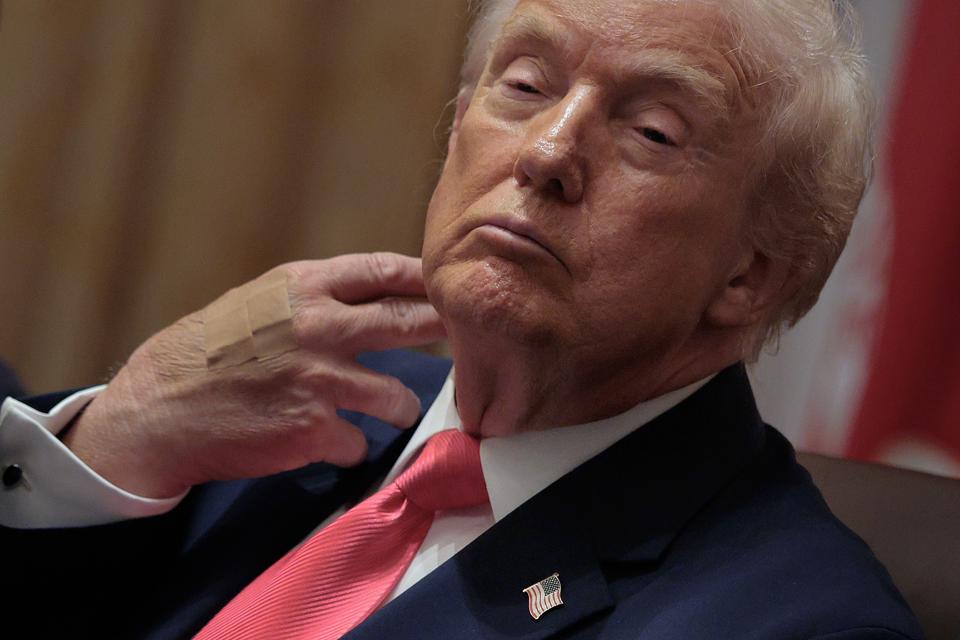
That history is why the Davos photos landed so hard. A recurring right-hand bruise can be explained as handshake wear and tear. A sudden, heavy bruise on the left hand, appearing mid-event, looked different. It invited a new round of questions even from people who had accepted the earlier explanation.
There is also a broader medical file the White House has already put on the record. In 2025, officials disclosed that Trump has chronic venous insufficiency, a common condition in older adults in which blood pools in the veins of the legs and can cause swelling. Doctors said tests did not show deep-vein thrombosis or arterial disease. Later, after reports that Trump had undergone an MRI, the White House clarified that advanced imaging at Walter Reed was preventive. Barbabella’s December 1 memo said cardiovascular imaging was “perfectly normal,” with no arterial narrowing, no clotting, and heart chambers of normal size. The official line has been consistent: the president bruises easily, he takes aspirin on purpose, and the big scans have not shown a hidden cardiac disaster.
Not everyone bought the table story
Online, the reaction split the way it always does with Trump’s health.
Skeptics focused on mechanics. “That’s a really odd place for a hand to hit a table while signing something,” one user wrote. “Unless he slammed it upwards into the table from underneath.” Others joked that he only ever seems to injure the back of a hand. The implication was that a table-corner bump should not produce a bruise that large and that well-placed, or that the White House was recycling a convenient story.
Defenders went the other way. Older adults bruise from minor knocks they do not even remember. One commenter wrote that at 75 they bruise “like this often without knowing how it happened. That’s called being a senior citizen.” Another said they had bruised a hip on a table edge at half Trump’s age. “Shit happens.” That camp treated the episode as proof of age and aspirin, not conspiracy.
Both reactions miss a quieter point. A bruise can be both ordinary and politically expensive. Presidents live under high-resolution lenses. A mark that would vanish in a private life becomes a national Rorschach test. The White House understood that, which is why officials moved so fast to say the bruise was new that day and why Trump answered the question on the plane instead of letting it sit.
What the episode actually tells us
Strip away the memes and three facts remain.
First, the bruise was real and highly visible. Independent outlets and fact-checkers confirmed the Davos photos showed genuine discoloration on the left hand during the Board of Peace ceremony. This was not a lighting trick.
Second, Trump and his staff offered the same two-part explanation: a bump on the signing table, amplified by high-dose aspirin and treated with cream. They also used prior photos to argue the mark was not present earlier in the trip.
Third, the episode sits on top of a year of visible hand marks, makeup, bandages, swollen ankles, and official memos that simultaneously disclose conditions and insist the president is in “exceptional” health. That combination — disclosure plus defiance — is now the administration’s default posture on anything that looks like a health story.
Medical reality is less cinematic than the comment threads. Easy bruising is common after 70. Aspirin makes it more common. A table edge can do real damage to thin skin. None of that proves the official story is complete, and none of it proves a hidden crisis. It does prove that every mark on this president’s hands will be photographed, magnified, and argued over.
Trump’s own framing is the one he wants voters to keep: he takes the “big aspirin” because he will not take chances with his heart, he clipped his hand on a table, he put cream on it, and he is “very good.” Whether that is enough for a public that has watched the same hands for a year is another question. The bruise will fade. The habit of reading his hands like a medical chart will not.