There are beautiful women, and then there was Raquel Welch. For more than half a century she occupied a category of her own: a 1960s sex symbol who refused to be only that, a Hollywood star who outlasted the poster that made her famous, and a woman whose face and figure became shorthand for an entire era of glamour. Born Jo Raquel Tejada on September 5, 1940, she died at her Los Angeles home on February 15, 2023, at 82, of cardiac arrest after living with Alzheimer’s disease. The image that first made the world stare never quite faded. What has grown clearer with time is how much more there was behind it.
:max_bytes(150000):strip_icc()/Raquel-Welch-021523_3-e7271a01df704818aca6133d0fccc419.jpg)
From Chicago to La Jolla: a dual heritage she claimed late
Welch was the eldest of three children of Armando Carlos Tejada, a Bolivian-born aeronautical engineer, and Josephine Sarah Hall, an American of English and Scottish descent whose family line reached back to the Mayflower. The family moved from Chicago to the San Diego area when she was two so her father could work in wartime aircraft design. She grew up in La Jolla, studied ballet from age seven to seventeen, and won local beauty titles including Miss La Jolla and Miss San Diego while still a teenager.
Her father did not allow Spanish to be spoken at home. For decades the public barely registered that one of Hollywood’s defining Anglo bombshells was Latina. Welch kept her first husband’s surname in part to avoid being typecast as a “Latin” actress. Late in life she reversed course. She learned Spanish in her sixties, played a Mexican American aunt in the PBS series American Family (2002), and said in 2015: “I still feel very, very Hispanic. The essence of who I am is a Latina.” A cousin, Lidia Gueiler Tejada, had already made history as Bolivia’s first female president.
She married high-school sweetheart James Welch in 1959, had son Damon that November and daughter Tahnee (Latanne Rene) in December 1961, and was divorced by 1964. After a difficult stretch as a single mother—weather girl in San Diego, then cocktail waitress and model in Dallas—she moved to Los Angeles in 1963 with two small children and an unshakable ambition.
The poster that changed everything
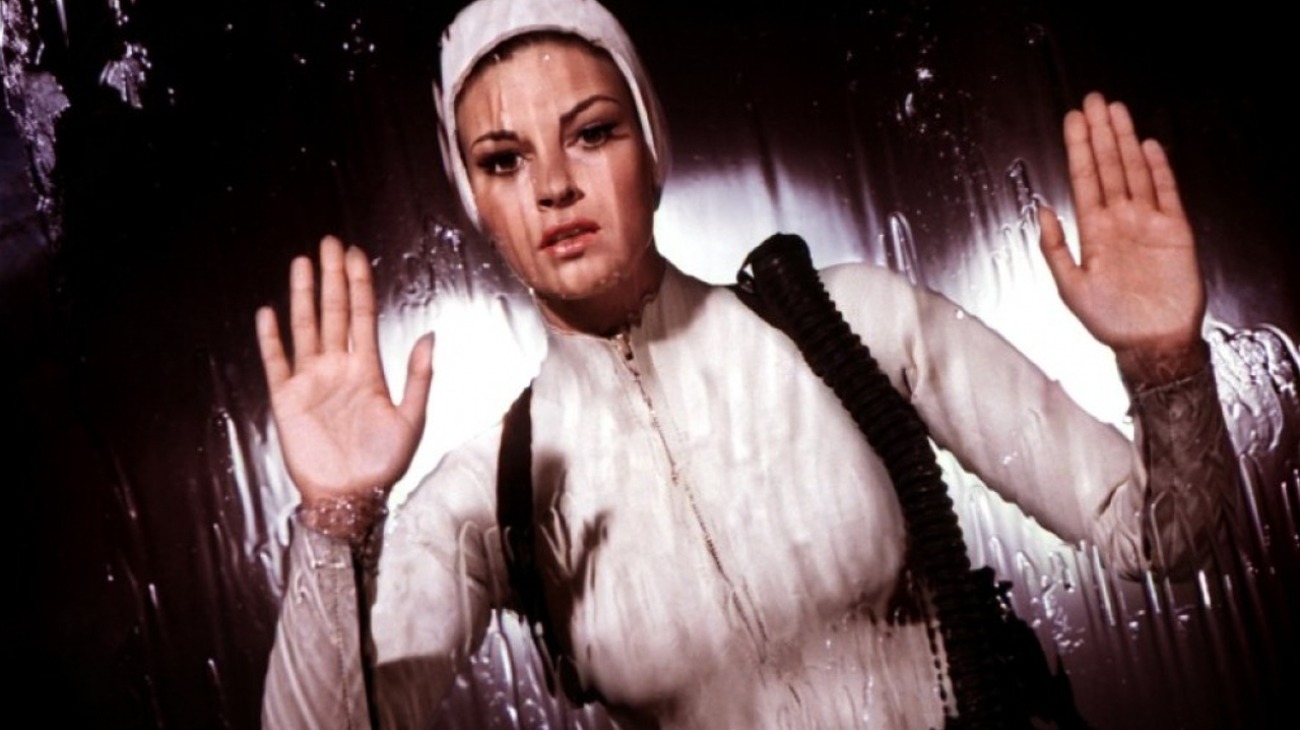
A press agent and future husband, Patrick Curtis, took her to Europe on a publicity tour that sold her face and figure before she had a real film career. Small parts followed, including a bit in Elvis Presley’s Roustabout (1964). Then 1966 delivered two films in the wrong order. Fantastic Voyage, the science-fiction thriller in which a surgical team is miniaturized and injected into a scientist’s body, was meant to be the prestige debut. Special-effects delays meant audiences first met her as Loana the Fair One in Hammer’s One Million Years B.C.
She had three lines. Costume designer Carl Toms draped her in deerskin and cut the now-legendary two-piece with scissors on set. A unit still of Welch standing in that fur bikini, legs planted, hair blown back against a prehistoric landscape, became one of the best-selling pin-ups since Betty Grable. The New York Times called her “a marvelous breathing monument to womankind.” Time later ranked the costume among the top ten bikinis in pop culture. The same poster later hid Andy Dufresne’s escape tunnel in The Shawshank Redemption. Welch herself was blunt: “I’m living proof that a picture speaks a thousand words.”
She never fully escaped the cavewoman. She also never fully accepted being reduced to her. “I just thought it was a goofy dinosaur epic we’d be able to sweep under the carpet one day,” she told the Associated Press years later. “Wrong.”

More than the bikini: films, comedy, and a Golden Globe
The late 1960s and early 1970s were a sprint: Bedazzled, Bandolero!, Lady in Cement opposite Frank Sinatra, 100 Rifles (notable for an interracial love scene with Jim Brown), the outrageous Myra Breckinridge, Hannie Caulder, Kansas City Bomber, and The Last of Sheila. She proved she could be funny. Richard Lester’s The Three Musketeers (1973) earned her a Golden Globe for Best Actress in a Musical or Comedy as Constance Bonacieux. She repeated the role in The Four Musketeers. Critics who had dismissed her as decoration had to recalibrate.

She drew a hard line on nudity. Raised conservatively, she posed for Playboy without going nude and repeatedly declined roles that required it. That stance cost her parts and, she believed, a certain kind of respect in an industry that often treated beauty as disposable. It also became part of her brand: sensuality with conditions.
On stage she replaced Lauren Bacall in Woman of the Year on Broadway in 1981–82 and later stepped in for Julie Andrews in Victor/Victoria. Television specials, guest spots, and a 1970 variety hour called Raquel! kept her in living rooms. She never stopped working, even when leading-lady offers thinned.
Four marriages, two children, and the cost of the myth
Welch married four times: James Welch (1959–64), Patrick Curtis (1967–72), French director-photographer André Weinfeld (1980–90), and restaurateur Richard Palmer (1999–2004). None lasted. She told Piers Morgan she had real feelings for each man and believed, at the time, they could build a life. “It was not in the cards.”
Motherhood was the subject she discussed with the most regret. Touring the world as “Miss Sex Symbol” meant long absences. She told Oprah Winfrey the toll on Damon and Tahnee “used to just break my heart.” Tahnee became an actress—best known for Cocoon (1985)—and spent years deflecting comparisons to her mother. Damon kept a lower profile. Welch is survived by both children and by her brother Jimmy Tejada.
Reinvention: yoga, wigs, and a second act as a brand
In the 1980s she published Raquel: The Raquel Welch Total Beauty and Fitness Program and released companion yoga videos directed by Weinfeld. The regimen—daily hatha yoga, no alcohol or tobacco, meticulous skincare—was not a celebrity fad so much as the method she had used for decades to stay camera-ready. She later launched the successful HAIRuWEAR wig line, a jewelry collection, and skincare. In 2007 she became a MAC Cosmetics Beauty Icon. Her 2010 memoir, Beyond the Cleavage, mixed beauty advice with frank talk about aging, body image, and the strange luck of being turned into an icon overnight.

Cameos kept arriving: Mrs. Windham Vandermark in Legally Blonde (2001), a late-career turn in How to Be a Latin Lover (2017) as a glamorous grandmother targeted by an aging gigolo. Photographers still followed her into her seventies. She still delivered the look.
What remains
Welch understood the bargain. “I was not brought up to be a sex symbol, nor is it in my nature to be one,” she said in 2018. “The fact that I became one is probably the loveliest, most glamorous, and fortunate misunderstanding.” The misunderstanding made her rich and famous and typecast. It also gave her a platform she used, eventually, to talk about heritage, discipline, and the difference between being looked at and being seen.

The fur bikini is still the first image most people summon. It is not the whole story. Raquel Welch was a dancer who was told she did not have the right body, a teenage mother who refused to stay in Texas, a contract player who sued a studio and won, a Latina star who spent decades passing as something else and then claimed the identity on her own terms, and an older woman who treated glamour as a craft rather than a gift that expires. She died more than three years ago. The photograph on the rocks is older than most of the people who still recognize it. Both keep circulating because they capture something rare: a presence that does not need many lines of dialogue to hold the frame.